



This page details the individual Commodity markets offered by the Spread Bet brokers, including some points to look out for, such as which months to trade and the importance of initial research into what you’re trading.
Spread betting on commodities is a way to speculate on the price movements without owning the physical commodities such as gold, silver, gas, oil and livestock. This type of derivatives trading essentially means you are betting on whether the price of the underlying commodity instrument will move higher or lower with leverage.
To open a bet, you place a stake per point that the chosen commodity’s price will rise or fall, and for every point the price moves, you will profit (or lose) your stake.
1. Large Range Of Markets
Brokers provide a large range of commodity markets that you can spread bet on, allowing you to benefit from lower commodity trading fees and tax-free profits on commodities. These markets range from precious metals like gold and silver to soft commodities such as wheat and cacao.
2. Low Pricing
I find that commodity spread betting offers competitive spreads compared to other trading methods. Spread betting companies offer low spreads (with no commissions) from 0.4 points on gold, which reduces your trading costs further and can help maximise your overall profits.
Profits generated from spread betting are exempt from capital gains and stamp duty tax in the UK, meaning you will not have to pay tax on your profits. No other financial derivative offers this, making it a unique benefit if you are a UK bettor, allowing you to keep more profits.
3. Portfolio Diversity
If you speculate on other products, such as shares, indices or major currency pairs, you can diversify your portfolio with commodities. For example, gold is considered a safe haven asset when inflation rises or the stock market falls, so betting on the price of gold rising would be a good bet.
So, you can spread bet on gold during these times to diversify your portfolio without storing (holding) physical gold and benefiting from the tax exemption on profits.
4. Leverage
Leverage is a popular tool built into commodity spread betting that lets you control significant positions with a small deposit of your funds (known as the margin). This means you can control a full position with a fraction of the funds that will magnify your profits should the price move in your favour – otherwise, it will amplify your losses.

For example, if you have £1,000 and have a leverage of 1:10, for every £1 you deposit as margin, you receive £10 as a loan from the broker. So, with £1,000 deposited as a margin, you can control a position of £10,000.
If the market rises 10%, you would make 10% of the £10,000, making you £1,000 profit (or 100% of the amount you deposited). If the market falls 10%, you’d lose £1,000, and your position would be closed.
5. Volatile Instruments
Volatility creates opportunities, and the commodity markets can be volatile with sharp price movements daily, impacted by geopolitical events, market sentiment shifts, or supply and demand.
All global news announcements generally impact oil and gold as they are paired with the US Dollar, but also due to the high demand for the commodities worldwide.
What Are Commodities?
Commodities are raw materials with intrinsic value based on the global economy’s needs for the material (or crop/livestock) that can be bought and sold. These raw materials have value because they are used for everyday things such as producing energy, crops to produce food, or technology (like copper and gold).
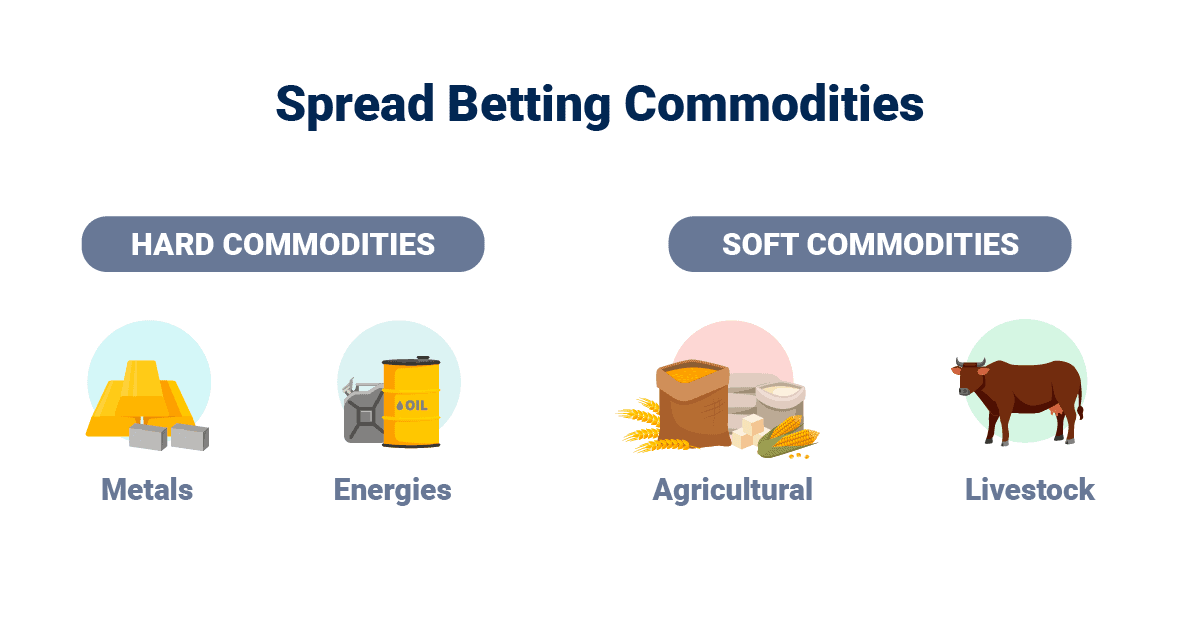
Commodities are grouped into two main categories:
Hard commodities: These are natural resources that are gathered from the earth, like oil and precious metals
Soft commodities: These are agricultural products farmed like wheat, coffee beans, and soybeans.
What Commodities Can You Spread Bet With
You can spread bet with a decent range of commodities, ranging from hard commodities like precious metals, gas and oil to soft commodities such as agricultural products.
Metals Such As Gold
One section of commodities you can spread bet with are metals, which are materials extracted from Earth and used in many industries such as technology and jewellery. Spread betting gold is one of the most popular markets you can find; it’s highly liquid and provides solid betting opportunities 24 hours a day.
Precious metals such as gold and silver are seen as a hedge against inflation and economic instability because they retain value and will always have a demand. While base metals are readily available and abundant, making them cheaper and commonly used in industries like technology and automobiles.
Spread betting has a wide range of markets, but not all metals are available. Below, I’ve included a list of the precious and base metals typically available:
Precious metals
-
- Gold
- Silver
- Platinum
- PalladiumBase metals
Base Metals
-
- High-Grade Copper
- Copper
- Aluminium
- Zinc
- Iron Ore
- Lead
- Nickel
Energies Such As Gas And Oil
Another important commodity you can spread bet on is the gas and oil markets, from 5 different markets (limited selection compared to the metal markets). I find that spread betting on natural gas and oil markets has the most volatility in price fluctuations, making it an exciting market to spread bet on.
The energy markets you can spread bet on are:
- US Crude Oil
- Natural Gas
- Brent Crude Oil
- Natural Gas – UK
- Heating Oil
Soft Commodities Such As Coffee And Wheat
Soft commodities are the crops and livestock that play a crucial role in food security and are essential for global food supplies. Seasonalities and weather can impact the price of soft commodities, so you should be aware of any droughts or floods in countries that produce the commodities.
Here is a list of the most popular soft commodities available on spread betting platforms:
- Wheat
- Corn
- Soybeans
- Rice
- Cotton
- Coffee
- Sugar
- Cocoa
- Orange Juice
Futures
Some brokers like IG Group provide spread betting on commodity futures, which reduces the nightly rollover fees but widens the spreads. Spread betting on commodity futures is ideal if you want to hold onto the position for longer than a week, as the trading fees will be lower over time.
Options
Another method of spread betting commodities is through options, which allows you to bet on the price direction of a commodity while benefiting from market volatility and limited risks.
With spread betting options, you pay a premium to open the bet, which becomes your maximum loss (no matter how far the market moves against you). Options have unlimited upside potential as you benefit from the price movement and the contract’s volatility, which can increase your profits further compared to traditional spread bet and CFD trading.
Which Brokers Are Best For Trading Commodities?
The best spread betting broker for trading commodities is Pepperstone with a decent selection of 20+ commodities and 1200+ markets and average spreads of 1.12 pips on EUR/USD.
In addition to low spreads on the broker’s markets, they offer a top selection of trading platforms like MetaTrader 4 (ideal if you want to automate your bets). Other platforms include TradingView, cTrader, and MetaTrader 5.
If you are more experienced and want to use specialised spread betting products like futures and options, IG Group and Spreadex are both top picks with these markets available.
Spread Betting Example Using Gold
To help you understand how to spread bet on commodities, I’ll go through a spread betting example using gold:
Let’s say you want to speculate on the price of gold with a spread bet to go long (to buy) because you expect the price to rise in the next few hours. You open a spread bet to buy at 1989.1850 and staked £1 per point (for every $1 gold moves, you make or lose £1).

The market rallies over the next few hours, and you decide to close for a profit. You closed at $1995.53, making you £6.34 profit ($1885.53 – $1989.1850 = 6.34 x £1 per point staked). If the markets fell $6.34 instead, you would have lost £6.34.

How To Start Spread Betting On Commodities?

Learning how to start spread betting on commodities is simple; below, I’ve highlighted the key steps you should follow:
1. Learn spread betting basics
Learn the concepts of spread betting, including crucial terms like leverage, margin, and spreads, while also understanding how to find profitable betting opportunities. You should open and use a spread betting demo account, and these provide a way to practise spread betting without risking your own funds.
2. Choose a broker and set up an account
Choose a Financial Conduct Authority regulated spread betting firm offering the commodity markets you want to bet on, ensuring the broker provides low spreads and fast execution speeds.
3. Develop a spread betting strategy
Develop a strategy that you can use to find profitable betting ideas while also managing your risk consistently.
4. Analyse the commodity markets for a bet
Once you have a strategy, analyse the markets you want to bet on (such as gold or oil) by following the rules from your strategy.
5. Open your bet
Open your bet by buying (bet on the price rising) or selling (bet on the price falling) the commodity chosen, enter your stake per point and execute your bet.
6. Close your bet
Monitor your position and close it to lock in profits or limit your losses.
FAQ
Are Commodities Good For Day Traders?
Spread betting commodities are good for day traders because there are many opportunities to bet on the asset throughout the day, especially as commodities are a 24/5 financial market. You also have access to leverage with spread betting, which allows you to profit from smaller commodity market movements (but it can also amplify your losses).

What Is The Spread In A Commodities Market?
The spread is the difference between the buy and sell price of the commodity on offer, and this is the fee the broker charges to execute your spread bet. Let’s say, for example, the buy price of gold is at 2000, and the sell price is 2001; then the price difference is 1 point (this is the spread.
If you want to work out the spread and the total trading costs associated with your spread bet, you should use a spread betting calculator that can help confirm your costs.
Commodities Spread Betting Legal In UK?.
Spread betting commodities is legal in the UK and you can spread bet on a wide range of commodities from crude oil to soybeans. The Financial Conduct Authority, one of the world’s top regulators, regulates spread betting, protecting you from malpractice within the brokering industry.
Is Spread Betting With Commodities A Good Strategy?
Spread betting with commodities is a good strategy as the markets tend to be very liquid (lots of activity) and volatile (lots of price movements). You can use the same financial spread betting strategies you’ve developed from other markets like forex trading, which can have similar results as the gold, silver, and oil markets are all paired with the USD.


